OirthirSAT is a student satellite team from the University of Glasgow developing a CubeSat to support improved monitoring of UK coastlines and coastal erosion. The project was awarded £600,000 through the UK Space Agency’s LaunchUK Nanosat Design Competition in 2022 and has since developed into a fully-fledged, student-led research project at the University of Glasgow.
Sustainability is central to the OirthirSAT mission. By providing timely and reliable measures of coastal change, OirthirSAT aims to equip decision-makers with better information to identify and support vulnerable coastal communities, while providing access to ready-to-use datasets on shoreline change. The STFC Higgs Centre for Innovation has played an important role in supporting the project by providing access to specialist pre-launch compliance testing, helping the team take a significant step towards preparing the satellite for flight.
The mission will demonstrate the use of onboard processing within a 3U CubeSat to analyse coastal imagery in orbit and generate responsive, critical, and compressed shoreline information for downlink, rather than transmitting large raw image files to Earth. This approach reflects a growing trend towards in-orbit data processing, including on nanosatellite platforms, where limited bandwidth and power make efficient information extraction increasingly important. By processing satellite imagery onboard, the team aims to support more timely and efficient coastal monitoring as an alternative to conventional approaches such as ground surveys, topographic data collection, and manual digitisation of aerial imagery, which can be costly, labour-intensive, and logistically challenging.
Challenge
To be accepted for launch, a satellite must first complete a series of qualification tests. These tests are required by launch providers to demonstrate that the spacecraft can survive the mechanical loads of launch and continue to operate as intended in the harsh environment of space.
As the University of Glasgow does not currently have access to the specialist facilities needed for this stage of CubeSat qualification, the OirthirSAT team sought an external testing partner capable of providing vibration testing. A key objective was for this testing to be delivered as a hands-on educational activity, ensuring that UK Space Agency funding was used not only to progress the mission, but also to upskill students and early-career engineers, helping to address the UK space sector skills gap.
Solution
The team found this support through the Higgs Centre for Innovation. Based at the Royal Observatory Edinburgh and co-located with the UK Astronomy Technology Centre, the Higgs Centre provides advanced facilities used by industry, academia, and government partners to develop, qualify, and test space hardware.
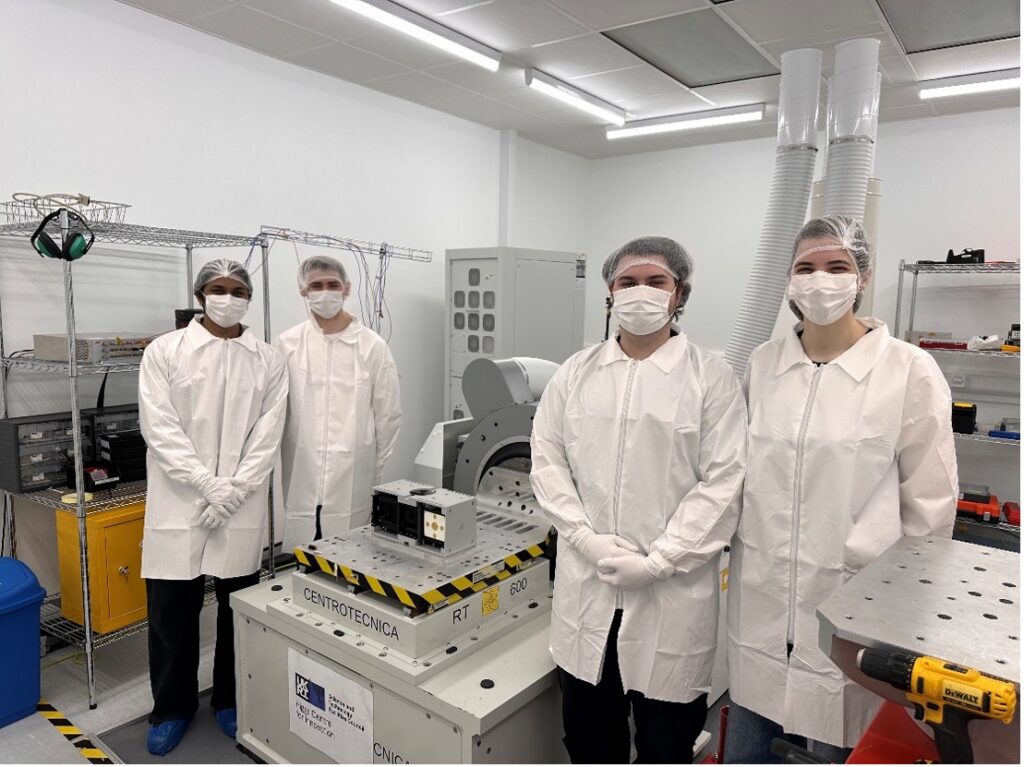
The Higgs Centre team supported OirthirSAT throughout the vibration testing process, from helping to identify test requirements and prepare supporting documentation, through to hosting the student team in the cleanroom on the day of testing. Students worked directly with experienced technicians and engineers, gaining practical exposure to live troubleshooting, design refinements, calibration of test parameters, and the vibration testing campaign itself.
Benefit
Through this collaboration, the OirthirSAT team gained valuable hands-on experience of professional space hardware testing. Working alongside expert engineers, the students were involved not only in the vibration test itself, but also in the supporting procedures, documentation, configuration control, and test-readiness activities required for a formal qualification campaign.
The campaign also provided practical lessons that can only be gained through direct involvement in hardware testing. This included experience in preparing the CubeSat for test, mounting sensors, managing harnessing and interfaces, assembling and reassembling the spacecraft, and understanding how small practical details can affect the smooth running of a test campaign. These insights will now inform the team’s internal verification and preparation activities at the University of Glasgow, helping students build confidence in carrying out functional checks, fit checks, inspection routines, and test rehearsals before future external campaigns.
As a result, the project has provided lasting value beyond the immediate vibration test. It has strengthened practical space engineering capability within the team, while giving students direct insight into the standards, discipline, and working practices involved in preparing real spacecraft hardware for launch. This experience will support their continued learning and provide a strong foundation as they move into future roles in the UK space sector.
“We can’t launch a satellite unless it’s been through qualifying tests. The city itself didn’t have anything that would work quite for what we needed, either due to size or it just wasn’t appropriate. So, then we found the Higgs Centre, which was able to accommodate not only for testing our CubeSat, which is what we needed, but in a way that would let it be an educational experience, so that we enter the industry as more experience professionals.” Orlie Meiksin, Senior AIT Engineer, OirthirSAT